The complete front door and entryway guide (the mouth of qi, room by room fixes)
The short answer: Make the door findable, lit and easy to open, keep the first meter or two inside clear, and give arrivals something good to land on instead of a straight line through the house. The four things that actually change how an entry feels: a working door, light, a clear landing zone for shoes and coats, and one object breaking the view straight through.
Feng shui has a hierarchy and it is not subtle: front door first, bedroom second, kitchen third. Everything after that is refinement. The front door has an actual name in the classical texts, the mouth of qi (气口), and it is where energy, opportunity, people and money are all said to enter. A practitioner walking into your home audits it before looking at anything else. This is the whole thing, outside to inside. At the end, four real entries, because which rules apply to you depends entirely on what your door opens onto.
Why the entry outranks every other room
Say the logic out loud and it stops sounding mystical: every other room can only work with what gets in through here. A bed in perfect commanding position behind a dark, blocked, sticking front door is a good room in a starved house. That is why the practitioner triage order is front door, then bedroom, then kitchen, and why “clutter at the entry” is read as blocked opportunity rather than just a mess. The version without qi in it: the first few seconds inside your home set your state, and you get them every single day. Walking into a wall of shoes and unopened mail is a daily message that you are behind. Nobody has shown a door harms your health. What is well supported is the light part (daylight drives your circadian rhythm) and the clutter part (visual clutter measurably taxes attention, and the famous cortisol study on messy homes is correlational and found the effect in women only). Both traditions end up telling you the same thing: get light in, clear the way.
The outside: people and qi both have to find the door
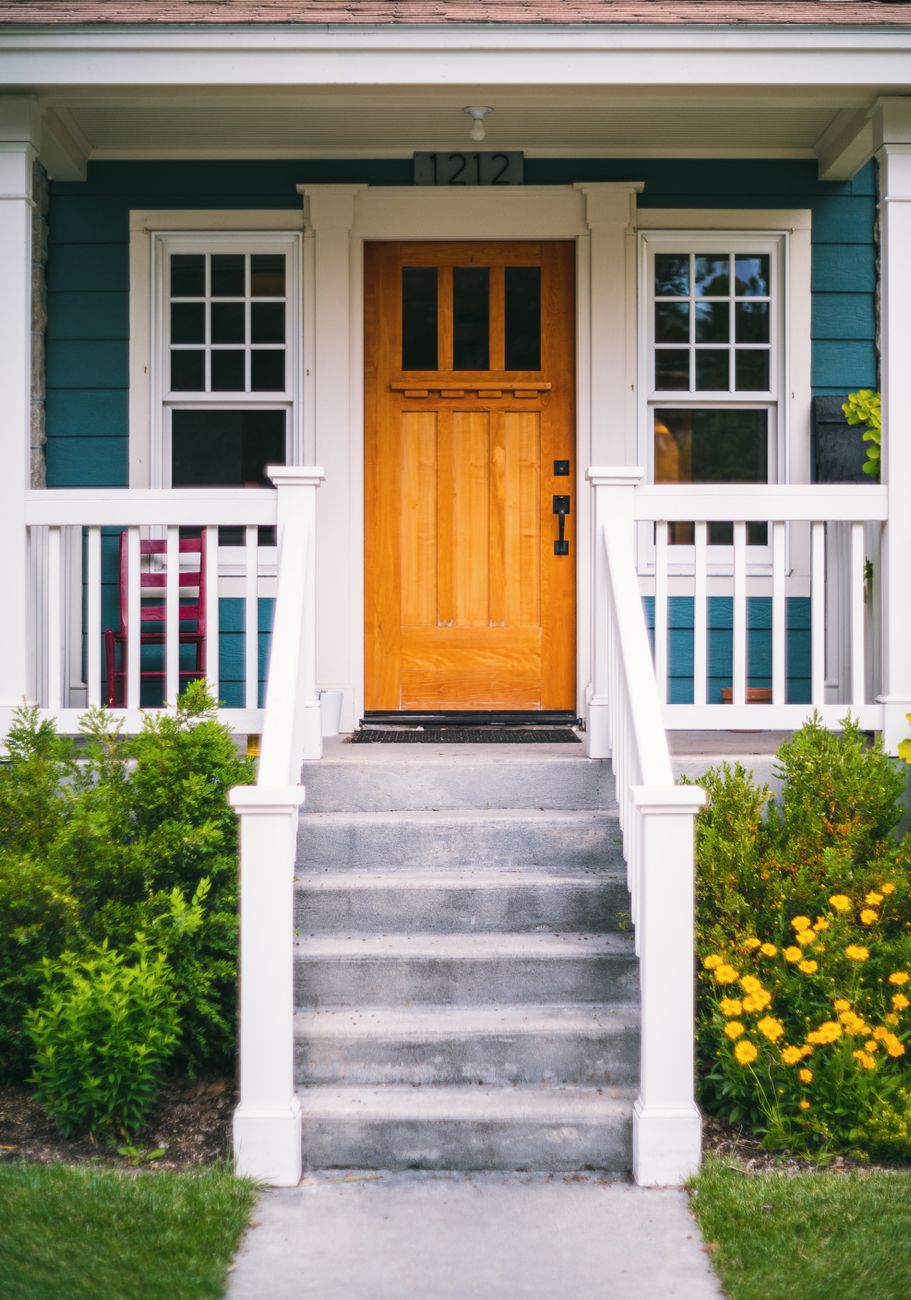
Classical rule: the door should be bright, clean, well lit and clearly numbered. The stated reason is that qi has to be able to find your door. The plain reason is that so do couriers, guests, and you at 11pm with your hands full.
- A visible house number and a working light. This is the cheapest fix in feng shui and the most ignored.
- A swept, unobstructed path. Bins, a dead plant, the bike nobody rides. Feng shui calls it blocked opportunity. Everyone else calls it an obstacle course.
- Curve the path if it shoots straight at the door. A straight run delivers rushing sha qi, a curve delivers gentle qi. You usually cannot move a path, so fake the curve: staggered stepping stones, planters offset left and right, a pot that makes you step around it.
- Fix whatever is broken, first. The tradition puts a number on it: repair within nine days or get rid of it. A cracked pane, a dead bulb, a wobbly number. Practitioners are unanimous that maintenance beats trinkets.
Poison arrows: the lamppost, the corner, the T junction
A sharp external thing pointed at your door (a lamppost, a neighbor’s roof corner, the sharp edge of the building opposite) is a poison arrow, sha qi, sometimes called a secret arrow. The classical cures: blur the line of sight with a hedge, a fence, dense planting, or a plant on the sill sitting directly in the arrow’s path. The traditional deflector is a convex bagua mirror above the door, outdoors only, and be warned that neighbors notice and mirror wars are a real thing.
T junction houses, where a road runs straight at your front door, get treated as one of the worst external positions there is. Here is the honest verdict, which is more interesting than the superstition: this one encodes a real problem. T junction houses do sell for less, and they genuinely take more traffic noise and more headlight glare through the front windows. The best cure is the physical one, not the symbolic one: a hedge, a fence or a low wall between the road and the door. Practitioners agree on that, which tells you something. A single lamppost or roof corner is a much weaker claim. Curvature research is solid on preference (people reliably rate curved forms more beautiful, and sharp shapes get a small threat flag in the brain), but in the study most often cited, curved rooms won on beauty and did not change whether people were willing to walk in. So: your brain mildly dislikes the corner, the corner is not hurting you. Screen it if it bothers you. Do not panic about it.
The door itself
- It must open fully, smoothly and silently. A sticking or squeaking door reads as restricted opportunity entering your life. Oil the hinges. This takes four minutes and it is on every practitioner’s landlord proof shortlist.
- Nothing behind the door. A door swings into the space being entered, and the design rule is that its swing arc stays completely clear. Coats hung on the back of a front door, a shoe rack the door bumps into, a bike parked behind it: all the same fault in two languages.
- Use it. If you always come in through the garage or the back, the mouth of qi is unused and the house is read as starved. Open it daily, get your post through it, come in that way sometimes. The unglamorous version: a door you never use is a door whose lock, light and hinges you never notice have failed.
Door color by direction (classical compass logic)
This is Classical compass feng shui, working from five element theory. The direction the door faces has an element, and the color should feed that element rather than fight it.
| Door faces | Element | Good colors | Avoid |
|---|---|---|---|
| South | Fire | Red, orange, strong yellow | Blue, black (water kills fire) |
| North | Water | Blue, black | Yellow and earth tones (earth dams water) |
| East or Southeast | Wood | Green, brown, blue, black (water feeds wood) | White and metal colors (metal cuts wood) |
| West or Northwest | Metal | White, gray, metallics, earth tones | Red (fire melts metal) |
| Northeast or Southwest | Earth | Yellow, beige, earth tones, red (fire feeds earth) | Green (wood breaks earth) |
Notice what that does to the famous lucky red door: red is only element correct for a south facing door. Many Western and BTB practitioners endorse red on any door anyway, as an activating and protective color. Classical practitioners say direction decides. The schools genuinely disagree here and neither has evidence, because element color theory and pop color psychology are both largely symbolic systems. What is actually reliable about color is brightness and light temperature, not hue. So treat the table as a fun constraint, not a rule you owe anyone.
What should not face your front door
- A staircase. Qi rushes straight up and starves the ground floor, or rolls down and out the door. Severity scales with how close the bottom step is. Fix: a substantial rug at the stair base to pool the arrival, a console or plant redirecting the path, bright light between door and stairs.
- The back door, or a big window straight ahead. The classic “money walks in and straight back out”. The old name is pierced heart, and the piercing hall (穿堂煞, chuan tang sha) covers the same idea. Fix: interrupt the line with a console, bookcase or folding screen, a round rug and round table just inside so qi spirals instead of races, a curtain on the back door kept closed, or a plant in front of it. Even a doormat at each end creates a pause.
- A mirror. The most repeated entryway rule there is: a mirror facing the door bounces incoming qi and luck straight back outside. It is also the one mirror question where the schools openly disagree, which we take apart separately. Fix: move it to a side wall, perpendicular to the door. There it expands a small entry instead of rejecting it, which is also the genuinely useful thing a mirror does in a tight hallway.
- A bathroom door. Incoming qi gets flushed immediately. Fix: keep that door shut, lid down, add a plant inside.
- The stove or the kitchen. Wealth on display leaks, plus the old line about guests who eat and leave. Fix: keep the kitchen door closed, or screen the sightline with a shelf unit or a tall plant.
- A blank wall within about 1.5 m. A wall in your face compresses the arrival. Fix: art with depth on it (a landscape, a path leading in) and a light to lift the space. A mirror here is debated, since it opens the space up but purists will not put one opposite a door.
- The sofa and your whole living room. Handled in depth already, so in short: the problem is not the door, it is the uninterrupted straight line to the seating. One tall object just inside, offset to one side, fixes it. Full version in the entryway sightline article.
What should greet you instead
Something beautiful and deliberate, and only one thing. Art, a healthy plant, fresh flowers, a good lamp, a rug that marks the spot. Practitioners call it the first impression principle: what you see first programs your state. That is a fair description of arrival psychology too, minus the qi. The area just inside the door has a real name worth knowing: the bright hall (明堂, ming tang). It wants to feel open, lit and intentional, not like a corridor of stuff you will deal with later. If you hang art here, the standard height is the center of the piece at 145 to 152 cm from the floor.
The first meter or two inside
This is where almost everyone loses the entry, and it is not a mystical failure. It is that shoes, coats and bags have nowhere to go, so they go on the floor. Build a landing zone and defend it. Hooks at adult height and a lower row for kids, a closed shoe cabinet rather than an open rack (an open rack is just a display of shoes), a small tray or bowl for keys, and a rug that says “this is the drop point, stop here”. Keep the main walkway at 90 cm clear, which is the standard minimum path through any room, and keep the door’s swing arc empty.
Why it matters beyond tidiness: this is the spot where you switch modes. If arriving home involves stepping over things and hunting for a place to put your bag, the switch never happens cleanly. Feng shui says the first meter or two sets the tone for the whole house’s flow. Same claim, different words.
Light
Light is the strongest crossover in feng shui. The tradition says qi enters with light and that dark corners collect stagnant sha qi. Circadian science says get bright light on your face, particularly early. Both send you to the same switch. Practical numbers: hallways and entries want 100 to 150 lux of general light, which is not much, but it has to be there and it has to be more than one sad overhead bulb. Minimum three light sources per room is the designer default, at different heights. In an entry, that is usually the ceiling fixture plus a small lamp on a console plus something washing a wall. Renters: a plug in lamp and a warm bulb in the existing fitting will do most of the job. Clean the glass in and around the door while you are at it. A dirty pane in a dark entry is throwing away your ration of daylight.
Now find your layout
Everything above is general. This part is not, because your floor plan decides which rules can even apply.
(a) You have a proper entrance hall
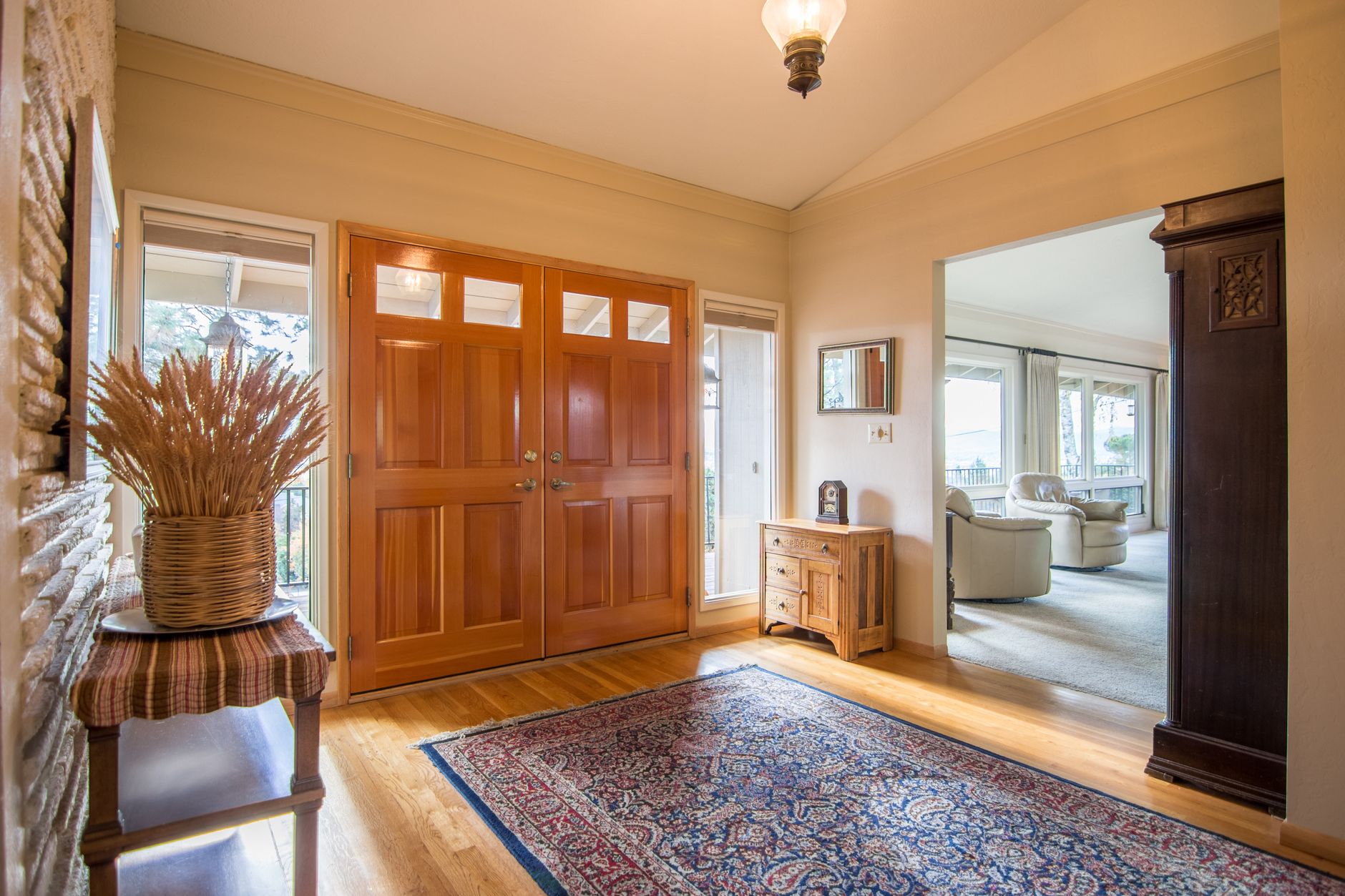
You have the layout the classical rules were written for. Use it. Console against one wall, mirror on a side wall perpendicular to the door, one rug, one lamp, closed shoe storage, hooks. Keep the sightline into the rest of the house partly closed, which is what a hall is for. The failure mode here is not energy, it is storage creep: a hall with a door you can close becomes the dumping room. Audit it monthly.
(b) The door opens straight into the living room
No hall means no threshold, so you build one. One tall object with visual weight just inside, offset to the side, never centered in the walking path: a plant around 1.5 m, a bookcase turned side on, a console. A rug at the door defines the arrival spot even when there are no walls. Get shoes and coats into a closed cabinet, because in this layout your entry clutter is living room clutter. Once the buffer is in, the rest is ordinary furniture placement, and the living room layout guide covers where the sofa goes from there.
(c) An apartment door into a narrow corridor
A long straight corridor is treated as a sha qi channel: energy accelerates down it like water in a chute, so the room at the end gets blasted and the rooms along it get skipped. It is also, in plain terms, a dark tunnel that makes a flat feel smaller than it is. Fixes are all rental friendly and they work for both reasons. A runner down the length, leaving 10 to 15 cm of floor visible each side, visually slows the walk. Art staggered on alternating walls makes the eye zigzag instead of tunneling. Two or three light points along the run instead of one at the end. A mirror on a side wall near the door, never facing it, buys you width. Keep the 90 cm path clear, which in most corridors means the shoe rack has to be shallow or has to go.
(d) The door opens onto a staircase
The worst of the classical layouts and one of the most common in terraced houses. Do the fixes in this order: substantial rug at the base of the stairs, then a console or tall plant to one side so the path bends, then light. A bright fixture between door and stairs is the traditional cure for lifting energy up and outward instead of letting it drain, and it also stops you climbing dark stairs with shopping bags. If you can hang something, the faceted crystal ball halfway between door and bottom step is the classic. It is symbolism, but it is cheap, and it puts light where there was none. Keep the under stairs cupboard tidy while you are there. Chaos under your path upward is the reading, and the practical version is that this cupboard becomes a black hole in every house.
What is classical, what is pop, what is just good design
- Classical: the front door as mouth of qi, the bright hall, the curved approach, poison arrows and bagua mirrors, door color by compass direction, the whole “should not face the door” list, the piercing hall.
- Western or pop: red on any door regardless of direction, most of the object magic you see on social media, anything promising money from a coin, frog or fountain by the door.
- Modern design common sense: clear the door swing, 90 cm walkways, three light sources at different heights, closed shoe storage, art at 145 to 152 cm, a runner in a long corridor.
- The real overlap: light, order, and being able to see where you are going. Those three are where feng shui and environmental psychology say the same thing in different vocabularies.
If you only do three things
- Oil the hinges, replace the bulb, clear everything out of the door’s swing. Twenty minutes, no money, and it is the fix practitioners rank first in the entire system.
- Give shoes, coats and keys a real home in the first meter, and put a rug where you want people to stop.
- Make sure the first thing you see is one good thing, not a straight run to the back window, the toilet, or your own reflection.
About ninety percent of feng shui is placement, light, cleanliness and objects, none of which need a landlord’s permission. The entry is the room where that is most true, and the one where you will notice the difference fastest, because you walk through it every day.
Further reading
- Feng shui · Chinese traditional practice
- Qi · Vital force in traditional Chinese philosophy
- Door · Movable barrier that allows ingress and egress
- Spirit screen
- Vestibule (architecture) · Small room leading into a larger space
- Mirror · Object that reflects an image
- Wuxing (Chinese philosophy) · Chinese five elements
Definitions and background from Wikipedia.
Quick questions
- What should you see when you walk in the front door?
- Something intentional and one thing only: a piece of art, a plant, a lamp, a rug that marks the spot. What you should not see is a straight run through the house to a back door or window, a staircase starting right at your feet, a toilet, or a mirror bouncing you back out. Practitioners call it the first impression principle. Plainly: whatever you see first every day is what your home is training you to feel.
- Is a red front door good feng shui?
- Depends who you ask, and this is a real schools disagree moment. Classical compass practice says the color follows the direction the door faces, so red is correct for a south facing door and wrong for a west facing one, because fire melts metal. Many Western and BTB practitioners endorse red on any door as an activating, protective color. Neither camp has evidence, so if the color police are the only thing stopping you, paint it whatever makes you glad to come home.
- My front door opens straight onto the stairs. What can I do without renovating?
- Put a substantial rug at the bottom of the stairs so the arrival has somewhere to land, and place a console or a tall plant to one side so you have to step around it rather than straight up. Good light between door and stairs helps more than any object. The traditional extra is a faceted crystal ball hung halfway between door and bottom step. That one is symbolism, but it is cheap and it does catch the light.