Studio apartment feng shui (how to zone one room that has to be everything)
The short answer: Give each function a boundary you can see: one rug per zone, the back of the bed or sofa turned toward the next zone, a shelf unit or a curtain on a tension rod between sleep and work, and a separate lamp for each area. The bed gets the commanding position first, the desk gets a mirror instead, and the work zone gets covered or folded away at night. None of it needs a drill, paint or a landlord's permission.
Feng shui was written for houses with rooms. Separate rooms, with doors, each one doing a single job. Then you moved into a studio, and one space has to be your bedroom, your office, your kitchen and your living room at the same time. Every rule about “keep the bedroom yin and the living area yang” hits the same wall: you only have one room, and it is doing everything.
The traditional reading of that is constant mixed signals. Rest never fully rests because the laptop is right there. Work never fully switches on because the bed is right there. You do not need the word qi to recognize that feeling. It is why studio living feels tiring in a way the square footage does not explain. So the whole job in a small apartment is the same job, over and over: give each function a boundary. Not a wall. A boundary you can see.
And because most people in studios are renting, every fix below is reversible. Nothing drilled, nothing painted, nothing you cannot undo the day you move out.
The renter’s rule, up front
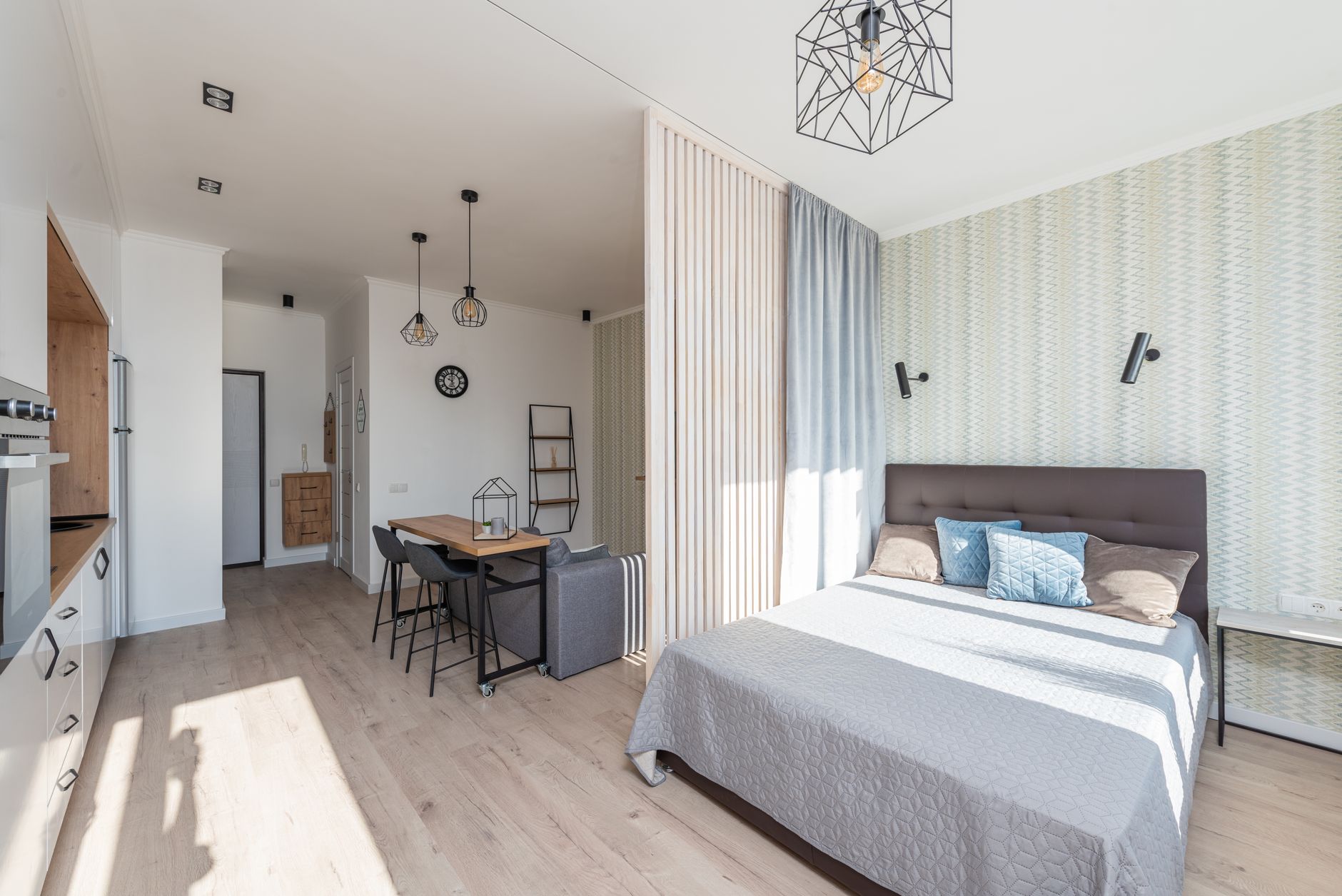
Roughly ninety percent of feng shui is placement, light, cleanliness and objects. None of those four require a landlord’s permission. That is not a consolation prize, it is genuinely most of the system.
The renter’s toolkit is short: furniture placement (free), mirrors and art on removable adhesive strips, plants, lamps, rugs, curtains on tension rods, and freestanding screens or shelf units. When you cannot change a fixed feature you hate, you cover it, soften it, or pull attention away from it. Fabric over an ugly built in. A plant in front of the radiator. A runner down a harsh strip of corridor. Cannot repaint a wall in the color you want? Layer that color in textiles instead. In element terms the energy does not care whether the green is paint or a throw, and in plain terms a cushion is cheaper than a deposit.
Zone the room: five things that work as walls
A visual boundary counts as an energetic boundary in feng shui, which happens to line up with how sleep advice already works: your brain wants a place that means sleep and a different place that means work. Five tools, in the order I would use them.
Rugs. One rug per life zone. Qi reads a rug as a room. So do you. This is the cheapest zoning move there is and the most under used. Keep 30 to 45 cm of bare floor between a rug and the wall, or about 20 cm in a really small room, and remember the sizing test: the front legs of every seat should land on the rug. A 160 x 230 cm rug is the apartment sized workhorse. Under a bed, the rug wants to run 45 to 60 cm past the sides and the foot.
Furniture backs. The back of a sofa or a bed is a low wall you already own. A headboard turned into the room lets the bed back onto the living zone. Put a narrow console behind a floated sofa and the sofa gains what feng shui calls a mountain: something solid behind the person sitting there. Most of the open plan advice in the living room layout guide applies here too, just at a smaller scale and with a bed in the mix.
Shelving. An open bookcase, standing free, is the best divider in a small flat. It blocks the sightline without blocking the light, and you get storage out of the same object. Keep it airy: about 60 percent books, 30 percent objects, 10 percent empty space, and leave a bit of every shelf clear so it does not read as a wall of stuff.
Curtains on tension rods. A tension rod wedges between two walls with no screws and no holes, which makes a full fabric divider a rental legal move. Draw it at night, push it back in the morning. Fabric over a bed also builds what feng shui calls a room within a room, the yin container a studio is missing. A canopy or a four poster does the same thing without dividing anything.
Lighting per zone. This is the one people skip, and it is the one that makes the zoning believable. A single ceiling light flattens the whole flat into one undifferentiated box. Give each area its own source: a task lamp at the desk, a warm low lamp by the bed, something at the sofa. A home office zone wants 300 to 500 lux general and 500 plus on the desk itself. A bed zone wants 100 to 200 lux and 300 for reading. Those are different rooms in light terms, even when they are two meters apart. Put everything on dimmers if you can, and switch a zone off when you are done with it. Scent works the same way for free: something calming near the bed, something sharper near the desk.
The bed and the desk both want the same corner
Here is the real conflict in a studio, and most articles dodge it. The commanding position is the strongest rule in feng shui: solid wall behind you, the door in view, not sitting in the door’s direct line. It applies to the bed. It applies to the desk. In a studio there is usually exactly one spot that satisfies it, and you have two pieces of furniture asking for it.
The bed wins. That is the practitioner answer and it is not close. The bed outranks the desk and the sofa in a studio. You are unconscious for a third of your life in that spot, and it is the most vulnerable state you are ever in. Set the bed first, then arrange everything else around what is left. The full version of that placement is in where to put your bed.
Then give the desk the workaround instead of the position. Being unable to see the door behind you is the actual problem, so solve that directly: a small convex mirror clipped to the monitor gives you a rearview of the doorway. A tall backed chair stands in as your mountain. A heavy bookcase behind the chair does the same, and it is doing double duty as your room divider anyway. Seeing the door, even reflected, beats every other consideration. The reasoning and the rest of the fixes are in the desk commanding position.
Why this rule is worth respecting even if you think feng shui is nonsense. This is the strongest crossover in the whole system. Jay Appleton’s prospect and refuge theory, from 1975, says humans prefer a clear view out with a protected back, and seating studies keep finding people choose wall backed, door facing seats. The evidence is decent rather than overwhelming, and nobody has shown that a badly placed bed harms your health. What is real is the low grade discomfort of not being able to see who walks in, and in a studio you feel it more, because the door opens straight into your bedroom.
If every wall fails, which happens constantly in small flats full of windows and radiators, buffer instead of moving. Bed in line with the door: a solid footboard, or a bench or trunk at the foot. No solid wall behind the head: a tall solid headboard, heavy curtains drawn at night, or a freestanding screen behind the bed. Window behind the desk: heavy curtain, closed while you work.
Hiding the work zone at night
The shutdown problem exists in any home office. In a studio it is worse, because you cannot close a door on it. Your work is in the room where you sleep, and it is the last thing you see. Feng shui’s version: work energy watching you sleep, the same objection as the TV in the bedroom rule. The plain version is that your brain uses location as a cue, and if the desk is visible from the pillow, the cue never changes.
What actually works, cheapest first:
- Close the laptop. Practitioners will tell you straight that this counts as a cure, and it is the one you will actually do every night.
- Throw a cloth over the monitor. Silly looking, genuinely effective.
- Fold away desk, wall mounted drop leaf or a small folding table, so the work zone stops existing at 6pm.
- Draw the curtain divider across the work zone. This is where the tension rod earns its money.
- Turn the desk lamp off and leave the bed lamp on. Switching the work zone into darkness is a shutdown ritual that takes one second.
Same logic, one room over: do not let the bed face the stove. Feng shui calls it fire energy staring at your sleep. Screen it with a curtain, a shelf unit or a folding screen. Aside from the symbolism, a kitchen is the noisiest, smelliest, most awake looking part of a studio, and it should not be the last thing in your eyeline.
Mirrors: the small space power tool that backfires
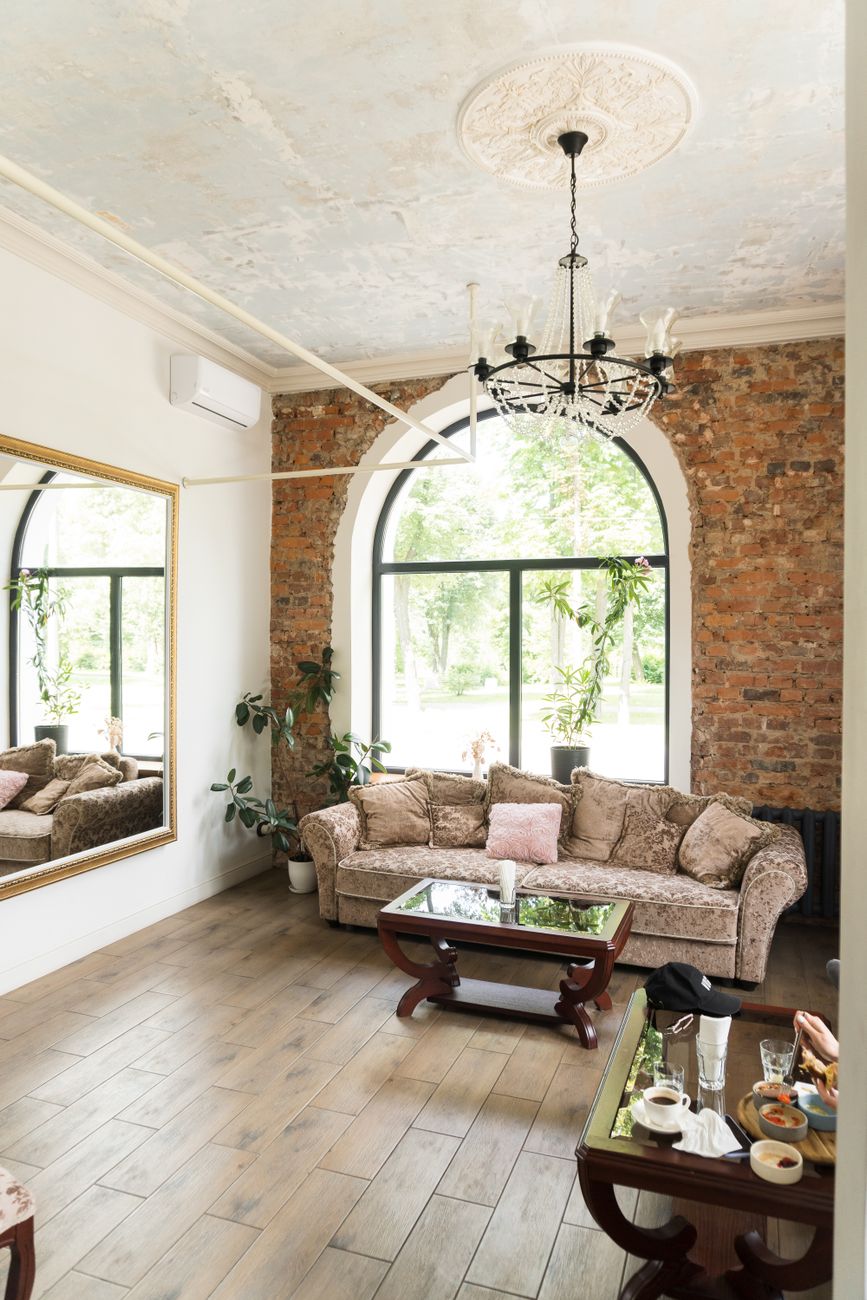
A mirror is the most recommended small space fix on the internet and the easiest one to get wrong. The difference is simple: a mirror doubles whatever it is pointed at.
Point it at something good. Reflect a window, so the daylight lands deeper in the room. Reflect greenery. Hang it perpendicular to the front door, which widens the entry without bouncing the incoming qi straight back out. Put one behind a lamp, so a single bulb reads as two. Mirror the wall beside a bulky built in and the bulk visually disappears.
Do not point it at something bad. A mirror facing clutter is twice the clutter. A mirror facing the toilet or the bin, same problem. A mirror facing another mirror is energy ping pong in feng shui language and genuinely disorienting in a small room. And a mirror facing the bed is the classical no, with the one mundane defense that holds up: catching your own movement in the dark sets off a startle response before you are awake enough to know what you saw. In a studio this happens by accident all the time, usually via mirrored closet doors. Angle them away or cover them at night.
Last thing: mirrors are yang, and a small space with too many of them never settles down. Two well placed mirrors beat six, and a broken or cloudy one gets replaced rather than kept.
Clutter, because a small space punishes it hardest
Clutter is the number one problem practitioners find in any home, and it disables every other cure. In a studio there is no spare room to absorb the overflow, so every extra object sits in your field of view all day. The feng shui mechanism is that qi behaves like water and light and flows around objects, so clutter becomes thousands of tiny dams and the room stagnates. The symbolic layer is more useful than it sounds: clutter is postponed decisions, so a junk drawer is a drawer of unmade choices, entry clutter reads as blocked opportunity and under bed clutter reads as baggage disturbing your sleep. Treat that as a prompt, not a diagnosis. The honest science line is thinner than the internet suggests: visual clutter does measurably tax attention, and one well known 2010 study linked women’s descriptions of a cluttered, unfinished home to a worse cortisol pattern. That study was correlational, showed up in women only, and measured how people talked about their homes rather than the actual mess. The direction is real, the pop version is louder than the data.
Storage rules that actually fit a studio:
- A trunk at the foot of the bed gives you a boundary and hidden storage in one object. Keep soft things in it, not junk.
- Under bed storage is the studio’s biggest win and the thing feng shui most dislikes. Compromise the way practitioners do: soft items only, in closed containers, nothing broken, nothing from an ex, and keep air moving under there.
- Go vertical: tall slim shelving takes the same floor area as a side table and holds ten times as much. Every object on it earns its place: do you love it, use it, or need it. If something is broken, fix it within nine days or get rid of it, because in one room you cannot look away from it.
- Keep the door swing zones and the main walkway clear. 90 cm for the main path through a room, 60 cm for a secondary one, 60 cm minimum at the sides and foot of the bed. Small flats break these constantly, and it is why a room can feel wrong when nothing looks wrong.
If your studio is dark or north facing
North is the water direction and the career sector, and in element terms it reads as cold. A flat with little direct sun is yin dominant. Strip the vocabulary away and you have the same problem in circadian terms: chronic darkness, chronic low energy. The fixes are all rental safe.
- Light as medicine. Daylight bulbs, and layers of lamps rather than one dead overhead fixture. Minimum three sources per room, at different heights.
- Mirrors positioned to bounce every ray deeper into the room, plus shiny and metallic surfaces to multiply what light you have.
- Warm colors in textiles: terracotta, warm yellows, red accents. Fire and earth against the cold, and no paint means no deposit lost.
- Clean the windows. Obsessively. Dirty glass in a dark home is throwing away your ration of light, and it is free to fix.
- Shade tolerant plants that actually stay alive, like pothos or a peace lily, so the room still reads as alive. A dying plant is worse than no plant in both languages.
- Lean into it. Dark rooms make good sleeping rooms. In a studio you cannot swap rooms, but you can swap zones: put the bed on the dim side and the desk and sofa on whatever side gets the light.
What is classical, what is pop, what is just good design
- Classical: the commanding position for the bed and the desk, the bed outranking everything else, no bed facing the stove, no mirror facing the bed, clutter as the first thing to fix, light and fresh air before any cure.
- Western or pop: most of the tidy bagua overlays sold for studio floor plans, and any object promising to fix a small flat by sitting on a shelf.
- Modern design common sense: rug sizes, walkway clearances, lux levels per zone, three light sources per room, vertical storage.
- The overlap worth keeping: face the door, clear the clutter, get light in, open the windows. Feng shui and environmental psychology say those four in different vocabularies, and they are the four that matter most when everything happens in one room.
If you only do five things
- Put the bed in the commanding position first, and arrange the rest of the flat around it.
- Buy one rug per zone. Sleep, work, sit. That alone changes how the room reads.
- Get a shelf unit or a tension rod curtain between the bed and the desk.
- Give every zone its own lamp, and switch the work zone off at night.
- Clear the entry, clear under the bed, and fix or bin whatever is broken.
Not one of those needs a drill, a paint brush or a conversation with your landlord. Which is the point: the parts of feng shui that survive contact with a rented studio are exactly the parts that were doing the real work anyway.
Further reading
- Feng shui · Chinese traditional practice
- Studio apartment · Type of apartment
- Qi · Vital force in traditional Chinese philosophy
- Jay Appleton · British geographer
- Room divider · Furniture used to divide a room
- Mirror · Object that reflects an image
- Circadian rhythm · Natural internal process that regulates the sleep-wake cycle
Definitions and background from Wikipedia.
Quick questions
- How do you divide a studio apartment without building anything?
- Rugs, furniture backs, shelving, curtains and lamps. One rug per zone, because qi reads a rug as a room and so does your brain. Turn the back of the bed or the sofa toward the next zone so it works as a low wall. Stand an open bookcase between sleep and work. Hang a curtain on a tension rod, which wedges between two walls with no screws. Then give every zone its own light source, so you can switch a zone off. All five are removable and none of them need a landlord's permission.
- Where should the bed go in a studio?
- The bed outranks everything else, so it gets first pick. Solid wall behind the headboard, the front door in view, and not sitting in the door's direct line. Then place the desk and the sofa around what is left. If the bed can see the stove, screen it with a curtain, a shelf unit or a folding screen, because feng shui does not want fire energy staring at your sleep and you do not want to fall asleep looking at last night's pan.
- Do mirrors really make a small apartment better?
- Sometimes. A mirror helps when it reflects a window, daylight or greenery, when it sits perpendicular to the front door, or when it stands behind a lamp. It hurts when it reflects clutter, because you have just doubled the clutter, and when it faces the bed, which is the one classical mirror rule with a plain explanation behind it: waking up to a moving shape in the dark triggers a startle response. Mirrors are yang, so a small room with too many of them never settles.