Home office layout: how to set up a work space in the room you actually have
The short answer: Start with the desk facing the door with a solid wall behind you, then fix the rest of the room: daylight on the side of your screen instead of behind it, a task lamp, storage that hides the mess, and a way to shut the work away at night. Which rules apply depends on where the desk lives. A desk in the bedroom needs screening and a shutdown ritual more than it needs anything else.
Almost every home office guide starts the same way: pick a quiet room with a door. Great, if you have one. Most people do not. The desk ends up in the bedroom, in a corner of the living room, or in the dead space under the stairs, and every rule shifts depending on which of those you are dealing with. So: the desk position first (briefly, because it has its own article), then the rest of the room, then the four layouts.
Desk position, the short version
Feng shui calls the good spot the commanding position: you can see the door from your chair, you are not directly in line with it (diagonal is ideal), and there is a solid wall behind your back. The psychology name for the same instinct is prospect-refuge, and seating studies back up the preference. If you cannot get it, a small mirror that shows you the door does most of the job.
That is the whole summary. The full version, including what to do when every wall in the room fails, is here: your desk position is sabotaging your focus.
Now the parts nobody covers.
What is in front of you
Feng shui says do not sit facing a blank wall at close range. The reading is a blocked career, an obstacle in your face all day. The prescribed cure is art with depth: a landscape, a path leading into the distance, water leading in.
Honest label: that is symbolism, not a finding. But the practical version holds. Your eyes need something to focus on further away than 60 cm, and a wall 40 cm from your nose gives them nothing. Depth in the artwork is a cheap stand-in for a view. If you have a real view, take it, but put it to the side of the desk rather than straight ahead: a window in your direct line of sight is a bright object your eyes keep readjusting to.
What is behind you (including on calls)
Feng shui wants a solid wall behind you: your mountain, meaning support and backing. A window behind you counts as no support, and the cure is a high-backed chair, a heavy curtain, or plants on the sill.
There is no ancient rule about video calls, obviously. But it lands in the same place. Whatever is behind you is what forty people a week stare at, and it is also what your own brain knows is at your back. A bookshelf, a plain wall, or one piece of art does both jobs. Things to avoid behind you on camera: a mirror (it shows your screen to the room), an open doorway into the rest of the house, a bed, and a pile of laundry you have stopped seeing. A blurred background is a patch, not a fix. The room is still like that when the camera goes off.
Storage, and the clutter you no longer notice
Clutter is the number one thing feng shui practitioners find in a home, and it disables every other cure. The mechanism they give: qi flows like water and light, so every pile is a small dam and the room fills with stagnant pockets. The symbolic layer is that clutter is postponed decisions. A junk drawer is a drawer of unmade choices.
The psychology version is thinner than the internet claims but points the same way. Visual clutter measurably competes for your attention, which is exactly the resource a desk exists to protect. Saxbe and Repetti’s 2010 study found that women who described their homes as cluttered and unfinished had flatter daily cortisol patterns and worse evening mood. Worth saying out loud: it was correlational, it showed in women only, and it measured how people described their homes rather than the actual mess. So “clutter spikes your cortisol” is oversold. “A desk buried in paper costs you attention” is not.
- Closed storage beats open shelving for a work zone. Open shelves are honest and pretty and they mean every object you own is in your field of view for eight hours.
- One tray for live paperwork, one drawer for the rest. If it is out on the desk, it is claiming attention.
- Cables. A tangle under the desk is the one pile nobody deals with. A cheap cable tray screwed under the desktop removes it from sight in twenty minutes.
- Fix or bin anything broken. Feng shui’s rule of thumb is nine days: repair it or release it. Broken things broadcast broken all day, and practitioners are unanimous that maintenance beats trinkets.
Light
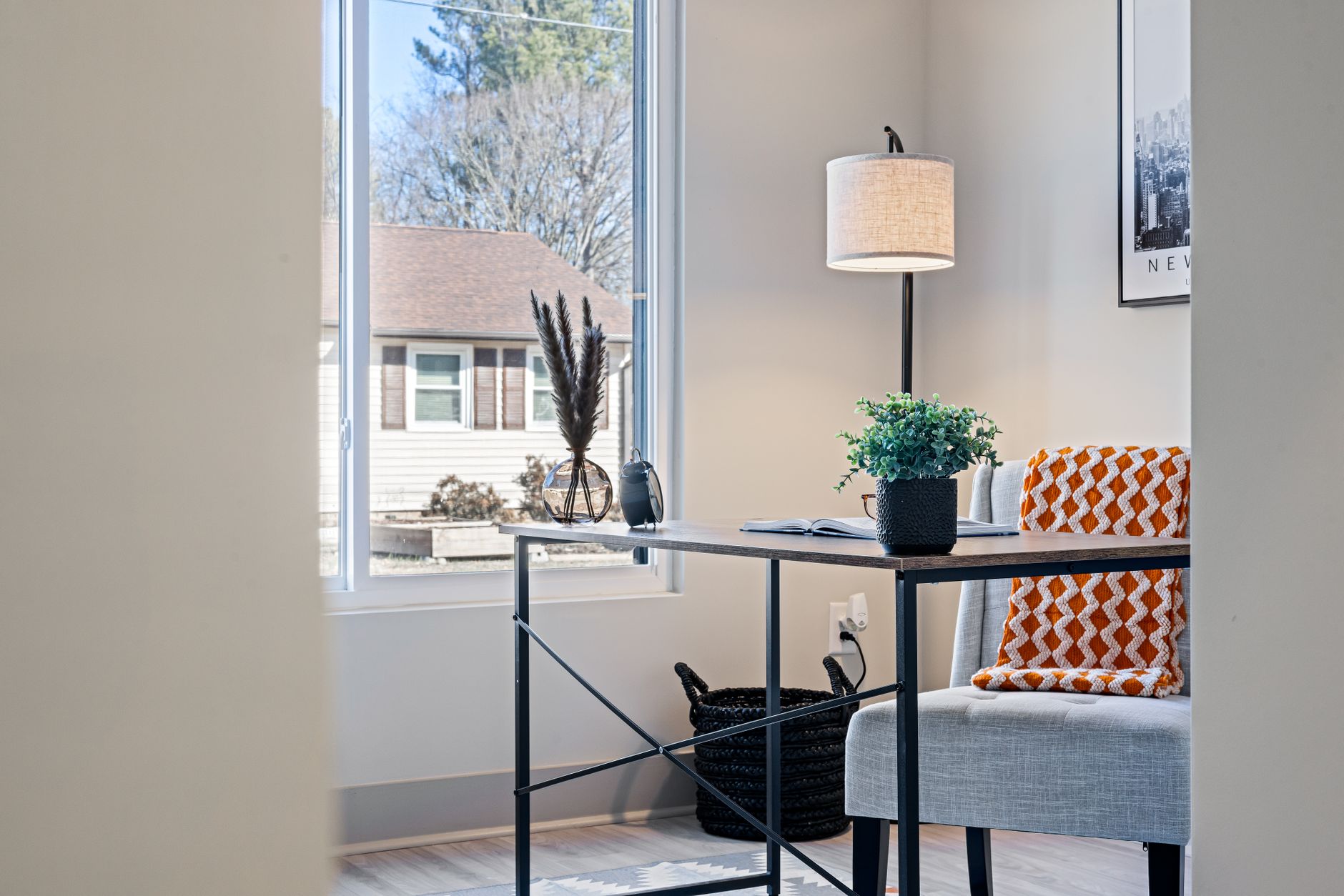
This is the one where feng shui and the research say the same thing loudest. Feng shui: qi enters with light, dark corners collect stale sha qi. Circadian science: daylight sets your body clock, and dim windowless spaces reliably worsen alertness and mood. Boubekri’s 2014 office study found workers near windows slept around 46 minutes more per night. Small sample, but it fits a large literature.
Practical setup, in order:
- Daylight from the side. Not in front of you (glare in your eyes), not behind you (glare on the screen). Side-on gives you the light without either problem.
- A task lamp anyway. Daylight does not last through a working day in winter. One overhead fixture doing all the work is the most common lighting mistake in a home. Layer it: overhead plus a lamp on the desk.
- Get the color temperature right. In a home, 2200K to 2700K is living room and bedroom light, 3000K is the warm-neutral work-friendly setting for kitchens and bathrooms, and 3500K to 4000K is neutral to cool white, already office territory. For a home office, 3000K to 4000K. Above 5000K is daylight bulbs, which belong in art studios and detail hobby work, not a room in your house.
- Do not mix temperatures in one room. A 2700K lamp next to a 4000K ceiling light looks broken and you will never work out why the room feels off.
- Buy CRI 90+ bulbs. Cheap LEDs sit around CRI 80 and are usually terrible at rendering saturated reds, which makes skin tones grey and wood look dead. It costs very little more and it is the difference between a room that looks designed and one that looks cheap at night.
If the room is genuinely dark, the fix is layered lamps and clean glass, not white paint. High-reflectance paint only works if light reaches it. A dim white room reads grey.
Air
The strongest science in this whole subject, and feng shui got there first with “stale air is stale qi, open the windows.”
Harvard’s COGfx studies found cognitive test scores roughly doubled under enhanced ventilation compared with conventional conditions, and a follow-up field study found 26% higher cognitive scores in green-certified buildings. CO2 and VOC levels directly impair decision-making. Indoor air is routinely two to five times more polluted than outdoor air. Caveat worth stating: COGfx was partly funded by green-building interests and the lab conditions were extreme, but the CO2 and cognition link has been replicated independently.
Translation for a home office: open the window for a few minutes every couple of hours, especially in a small closed room with the door shut. If your afternoons feel like wading through mud, try that before you try a supplement. A cheap CO2 meter is the fastest way to find out whether the room is the problem.
The shutdown problem
The real failure of a home office is not that you cannot start. It is that you cannot stop. Feng shui frames this as yin and yang: work is active, rest is passive, and when the two share a space neither one lands properly. Rest never fully rests, work never fully switches on. You do not have to buy the energy language for the behavioral point, which is that your brain uses places as cues and a visible desk is a cue.
- Close the laptop. Practitioners genuinely count this as a cure. It is the smallest possible version of putting work away.
- A cloth over the monitor, or a fold-down desk that disappears. If your desk is in a room you relax in, this is the highest-value habit in the article.
- A different lamp for the evening. Turning the work light off and a warm lamp on is a switch your body reads faster than a to-do list.
- Scent zoning. Feng shui practitioners suggest activating scents like citrus near the desk and calming ones like lavender near the bed. No hard evidence attached, file it under ritual, but rituals do reliably reduce anxiety and increase your sense of control, and that is not nothing.
Now, the four layouts
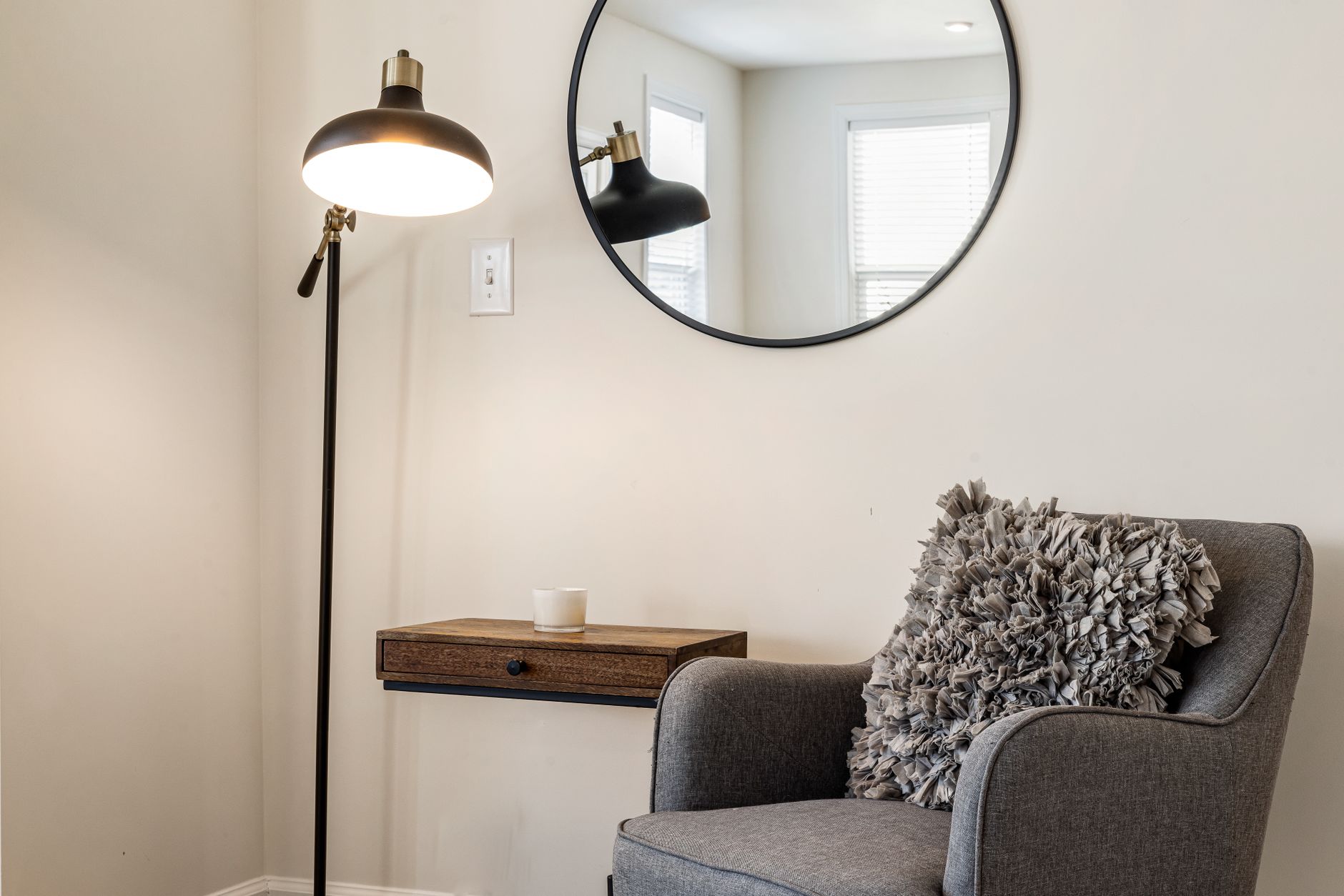
(a) A dedicated room with a door
The easy case, and the one where all the classical rules apply cleanly. Desk in the commanding position, solid wall behind you, door in view, art with depth on the wall you face.
Two things people with a real office still get wrong. First, they light it like a bedroom: one warm overhead fixture and nothing on the desk. Second, they let it become the room where everything homeless ends up (the ironing board, the boxes, the spare chair). A dedicated office quietly turning into a storage room is the most common version of the clutter problem. The advantage you have is the door. Closing it at 18:00 is a free shutdown ritual.
(b) A desk in the bedroom
The hardest one, and the most common. Feng shui is blunt here: the bedroom is a yin room, you spend six to nine hours a day in it in a passive state, and work energy does not belong. Practitioners put a desk in the bedroom in the same category as a TV facing the bed or exercise equipment in the corner. That maps almost exactly onto modern sleep-hygiene advice, which says keep the bedroom for sleep.
If you have no choice, work down this list:
- The bed gets the commanding position first. In a room that has to do both jobs, the bed outranks the desk. Solid wall behind the headboard, door in sight, out of the door’s direct line. The desk takes whatever is left.
- Do not let the bed and desk face each other. Working while looking at your unmade bed and sleeping while looking at your inbox is the whole conflict in one sightline.
- Screen it. A bookshelf, a folding screen, or a curtain on a ceiling track. Feng shui treats a visual boundary as an energetic one, which conveniently matches sleep psychology: your brain wants the sleeping zone to be its own place. Even a rug that contains the bed area counts.
- Cover the desk at night. Cloth over the monitor, laptop shut, chair pushed in. Work watching you sleep is the bedroom version of the TV rule.
- A canopy or four-poster over the bed builds a room within a room if you cannot fit a screen. Instant yin container, no walls needed.
- Two light circuits. A daylight-ish task lamp at the desk, warm light everywhere else, and never both on at once.
One bonus: if you have a north-facing room, it is a better study and bedroom than a living room, because the light is flat and cool and consistent all day. Give the bright side of the home to the rooms where you want energy.
(c) A desk in the living room or an open-plan space
The problem here is containment. Open plans give qi nothing to hold it, so it either races through the space or puddles in odd corners. In plain terms: no walls means no zones, so nothing feels like anywhere.
- Give the desk its own island. A rug under the desk and chair reads as a room. Feng shui reads rugs as rooms too, which is a nice coincidence.
- Use furniture as implied walls. The back of the sofa, a console, a low bookcase. A shelf unit behind your chair is both a room divider and the solid mountain the commanding position wants.
- Drop the ceiling with light. A pendant or a floor lamp over the desk zone makes a visual room out of nothing. Feng shui-adjacent, mostly just good interior design.
- Get out of the traffic lane. The corner desk in a walkway is why you cannot concentrate: people passing behind you all day, each one a small startle. If you cannot move it, clip a small convex mirror to the monitor.
- A big plant works as a soft pillar where a shelf would feel like a wall.
The corner spot people default to (desk shoved into the angle, back to the whole room) is the worst option in the room. Turn it ninety degrees so you have a wall or a shelf behind you and the room in front.
(d) A desk in a hallway or under the stairs
The nook everyone on Pinterest loves and nobody warns you about. Feng shui reads a long straight corridor as a sha qi channel: energy accelerates down it like water in a chute, and anything sitting along it gets bypassed or blasted. Under-stairs space gets its own warning, because chaotic storage under the stairs reads as instability under your path upward. Sloped ceilings press down, so do not put your head under the lowest point.
The plain version of all three is the same. A hallway is a thoroughfare, people pass behind you constantly, the light is usually terrible, and the space was never designed to be sat in. What to do:
- Sit facing along the corridor, not into the wall. If you can see who is coming, the passing traffic stops being startles.
- If the wall is your only option, use the mirror. This is the layout where a small convex mirror on the monitor earns its keep.
- Slow the corridor down. A runner, art staggered on alternating walls so the eye zigzags, and lights at intervals. All three are the classical cures and all three genuinely make a corridor feel less like a chute.
- Overlight it. Hall nooks have no daylight. You need a proper task lamp here more than in any other layout.
- Sit under the tall part of the slope, with an uplight washing the low side to push the compression back, and keep the storage around you closed and tidy.
The renter’s version
Roughly 90% of this needs no landlord, no drill, and no paint: placement, light, cleanliness, and objects. The five that give you the most for the least are turn the desk so nothing important is behind your back, move the daylight to the side of your screen, add one good task lamp at 3000K to 4000K with CRI 90+, put closed storage where the paper piles up, and pick one thing you do every evening that means work is over.
Everything else here is refinement. Light, air, order, safety, then symbolism. That order is feng shui’s own hierarchy, and it happens to be the right one.
Further reading
- Feng shui · Chinese traditional practice
- Small office/home office · Category of business or cottage industry that involves from 1 to 10 workers
- Jay Appleton · British geographer
- Circadian rhythm · Natural internal process that regulates the sleep-wake cycle
- Color temperature · Property of light sources related to black-body radiation
- Remote work · Employees working from any location
- Indoor air quality · Air quality within and around buildings and structures
Definitions and background from Wikipedia.
Quick questions
- Is it bad feng shui to have a desk in your bedroom?
- Traditionally yes. The bedroom is a yin room, meant for rest, and work is active yang energy. Feng shui puts a desk in the bedroom in the same bucket as a TV or exercise equipment. If you have no other room, the fix is not to feel guilty about it: screen the desk off with a shelf, a curtain, or a screen, and close or cover it at the end of the day so it is not the last thing you see.
- Should my desk face a window?
- Not straight on, and not with the window at your back either. Facing the glass gives you glare and a bright background your eyes fight all day. Backing onto it gives you glare on the screen and, in feng shui terms, no mountain behind you. The side position is the one that works for both: daylight across the desk, no light source in your line of sight.
- What color temperature should a home office light be?
- In a home, 3000K is the safe pick, and 3500K to 4000K is as cool as you want to go before the room starts reading like an office block. Skip 5000K and up, that is art studio and hobby detail light, not a room you live in. Do not mix temperatures within one room, a 2700K lamp next to a 4000K ceiling light just looks broken.